
Why my first DM never mentions what we do
I ran both versions on my own profile. The pitch almost never gets a reply.
I ran two versions of the same first DM on my own LinkedIn profile.
Version one named what And.Reach does in the opening line. Version two said nothing about the service and asked one question about the person's own work.
The pitch version almost never got a reply. The no-pitch version is the one I still run today. On my own profile in September, 46 first messages turned into 8 replies. Not huge. But the pitch version wasn't getting close to that.
This issue is about why the first DM should never mention what you sell, and the exact opener I send instead.
The pitch DM asks for the sale before you have earned a reply
Most first DMs on LinkedIn do the same thing. Someone accepts your connection, and within a minute they get a message that explains what you do and asks for a call.
From your side it feels efficient. You got the connection, now you tell them the offer.
From their side, a stranger just walked up and started selling. They did not ask for it. They connected, maybe out of curiosity, maybe by accident. Nothing has happened yet that makes them want to read a pitch.
So they do the easy thing. They ignore it. On a profile sending real volume, that ignore rate is brutal. When I ran the pitch version, the replies basically stopped.
What the first DM is actually for
The first message has one job. Get a reply. That is it.
Not book a call. Not explain the service. Not qualify them. Just turn a silent connection into a two way conversation. Everything else happens after they answer.
Once you accept that, the pitch stops making sense. A pitch is a closing move. You cannot close someone you have not spoken to. The first DM is an opening move, and opening moves are small.
What happens between your DM and their reply
When the message is a pitch, nothing happens. They read it and move on.
When it is a real question, they do a quick check first. I did not think about this clearly until I watched my own reply patterns, but a few things happen in the few seconds before someone answers a stranger.
They glance at your profile (who is this). They check whether the question is actually about them or a template (is this real). And they decide if answering is worth 20 seconds (do I even care).
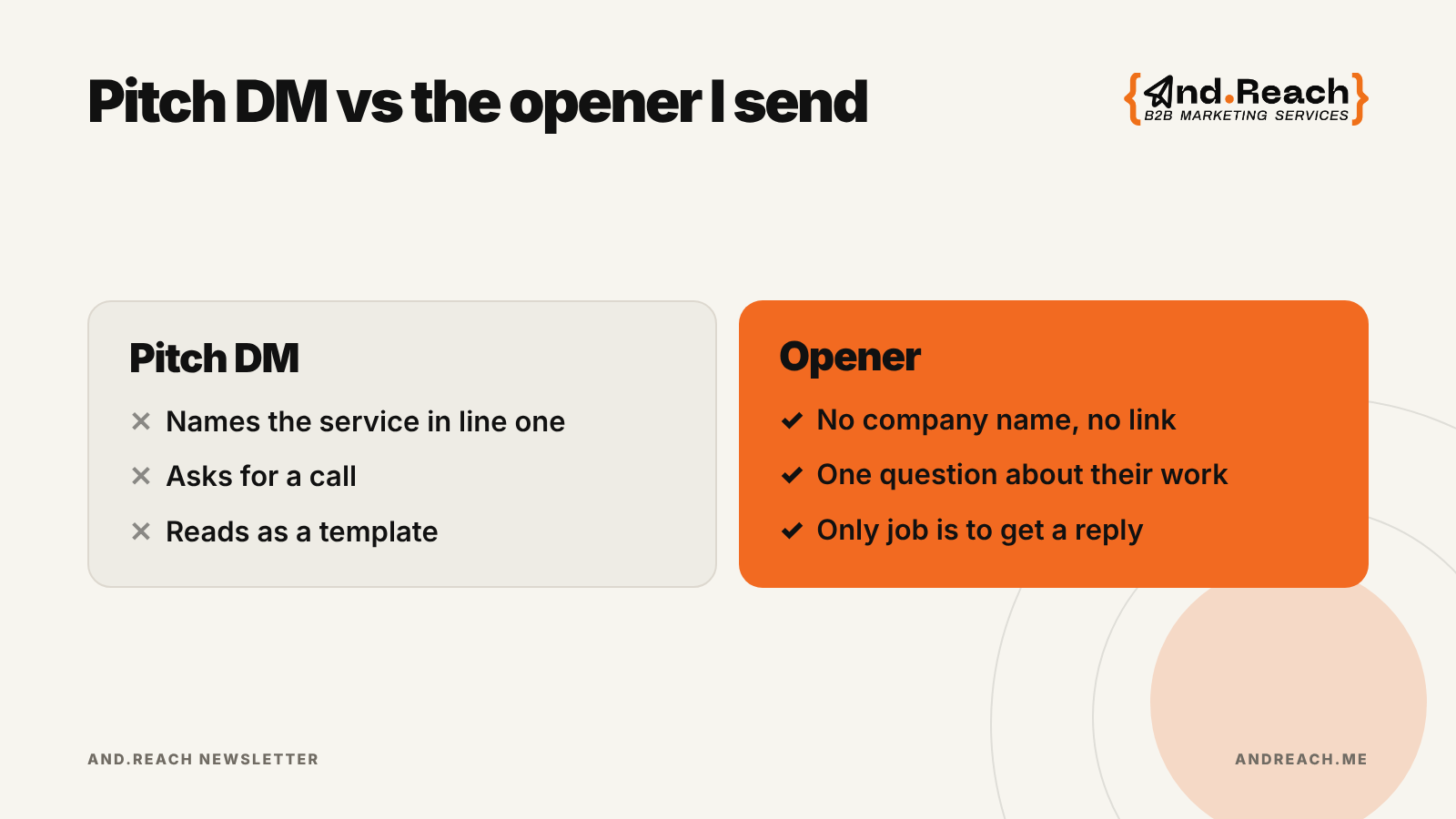
A pitch fails all three at once. It reads as a template, it is about you not them, and it asks for more than 20 seconds. A specific question about their work passes all three. That is most of why it gets answered.
The opener I send instead, line by line
Here is the shape I use. Three short bubbles, typed the way you would actually text, not one wall of corporate copy.
- A warm line that it is good to connect. One sentence, no agenda.
- One specific reference to their world. Something real from their profile or recent activity, not "love your content".
- One soft question about how they handle something in their work. Open enough that answering is easy, specific enough that it is clearly for them.
No company name. No "we help companies like yours". No link. No ask for time.
Example, for a founder running their own outbound:
Good to connect, [name]. Saw you are building the sales motion mostly in house right now. Curious, are you keeping outbound fully manual for now, or already testing some automation on top of it?
That last line is the whole trick. It is a question only they can answer, about a decision they are actually making. It costs them nothing to reply. And the reply is where the real conversation starts.
The number that made me stop pitching
I did not decide this from theory. I ran it.
On my own profile in September 2026, the no-pitch opener turned 46 first messages into 8 replies. Around 17 percent.
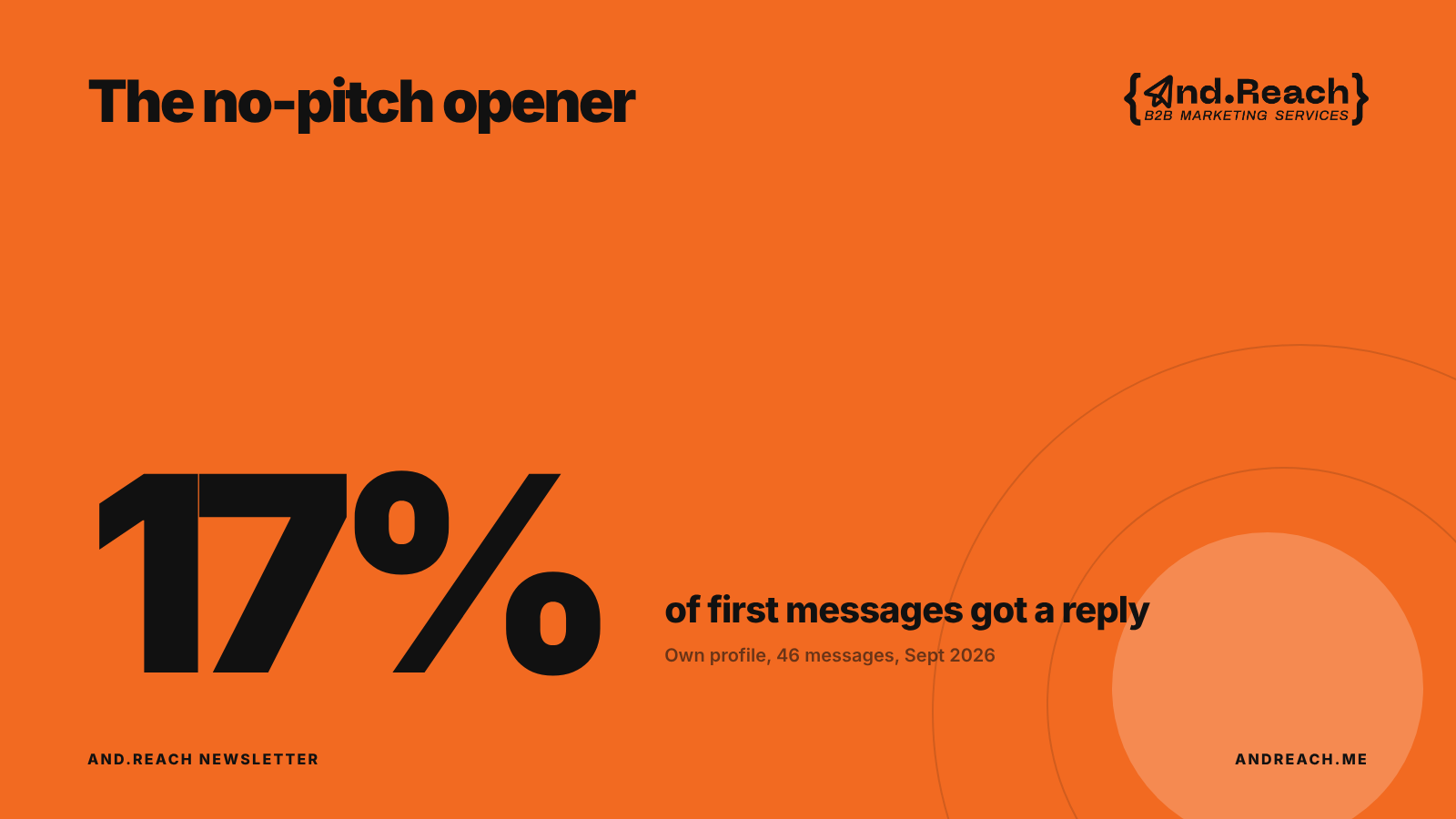
The pitch version never built a number worth saving, because it stalled fast. Almost nobody replied, so there was nothing to measure. That is the honest version. I did not run a clean, matched A/B test with two equal samples. I ran the pitch, watched it die, switched to the opener, and kept the opener because people answered it.
The first DM is an opening move, not a closing move. You cannot close someone you have not spoken to yet.
Where this does not work
This is not magic, and it is not for every market.
If your list is wrong, no opener saves it. A great question sent to the wrong person still gets silence. The message is the last 10 percent. The list and the targeting are the other 90.
It also needs you to actually reply fast when they answer. The opener starts a conversation, so if you let replies sit for three days, you throw away the one thing it bought you.
And it is slower than blasting a pitch to a thousand people. Fewer sends, more back and forth, more of your attention per lead. For high ticket B2B that trade is worth it. For a 20 dollar product it probably is not.
What I'd do this week
- Pull your current first DM. If it names your company or your offer in the first two lines, that is the problem.
- Rewrite it as three bubbles: warm line, one specific reference, one soft question about their work. Cut every sentence about you.
- Send it to your next 20 accepted connections and count replies. Compare it to your last 20 on the old message.
- When someone answers, reply like a person within the hour. Do not jump to the pitch. Keep the conversation going for at least two exchanges first.
One question for you. What does your current first DM say in its opening line, the actual words? Reply with it and I will tell you if it reads as a question or a pitch.